
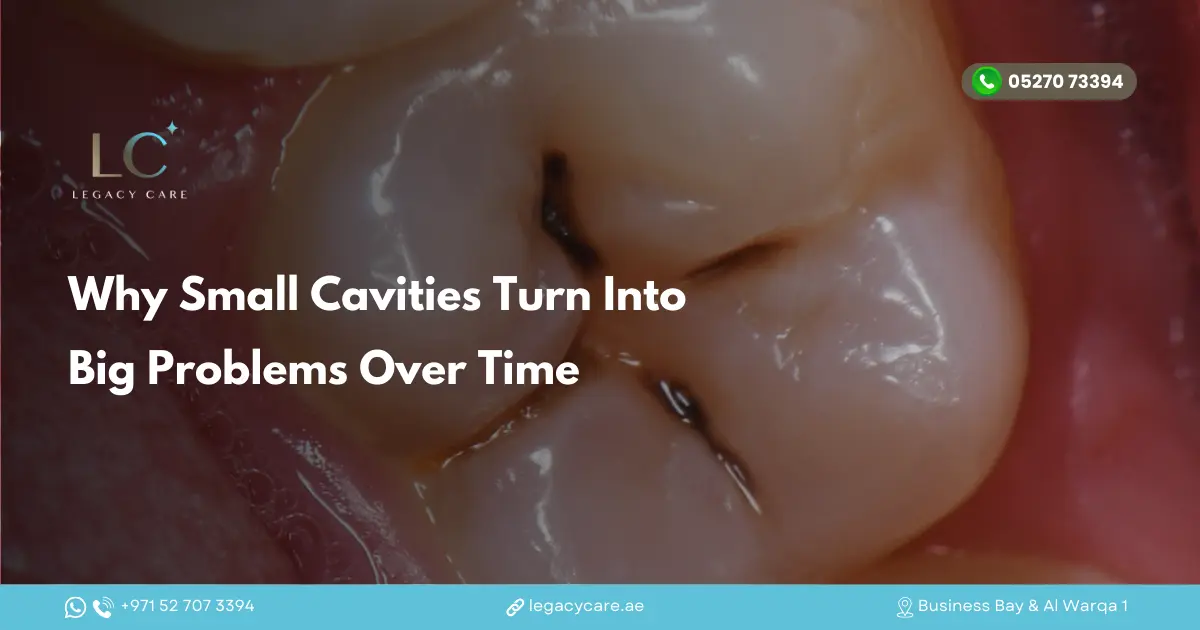
Most cavities don’t start with pain. That’s why they’re so easy to ignore.
A patient once told me, “Doctor, it was just a tiny black spot. I didn’t think it mattered.” Six months later, that same tooth needed a root canal. And that story? It’s very common.
Small cavities feel harmless. No pain. No swelling. No urgency. But inside the tooth, a slow process is already happening. And if it’s left alone, that small problem almost always grows into something bigger, more painful, and more expensive.
Let’s talk about why that happens.
How Cavities Actually Start
A cavity doesn’t appear overnight. It begins with plaque — a sticky layer of bacteria that forms on teeth every day. When plaque sits on the tooth surface, especially near the gums or between teeth, bacteria produce acid.
That acid slowly weakens the enamel. At first, it’s just a tiny soft spot. You won’t feel it. You won’t see it clearly. Sometimes, only an X-ray can catch it at this stage.
This is the “small cavity” phase. And this is the best time to treat it.
Why Small Cavities Don’t Hurt at First
Here’s something many people don’t realize. Tooth enamel has no nerves.
So when a cavity is limited to enamel, there’s usually no pain. That’s why people delay treatment. They think, “If it doesn’t hurt, it can wait.”
But the cavity doesn’t stop growing just because you’re not feeling it.
Under the enamel is dentin — a softer layer. Once decay reaches dentin, it spreads faster. Still, pain may be mild or come and go. This gives a false sense of safety.
By the time pain becomes constant, the cavity is no longer small.
What Happens When You Ignore a Small Cavity
When a cavity is left untreated, a few things happen step by step.
First, the hole gets deeper.
Then, bacteria move closer to the nerve.
Eventually, the nerve becomes inflamed or infected.
At this stage, you may feel:
- Sharp pain while eating
- Sensitivity to hot or cold
- Pain that wakes you up at night
- A bad taste in the mouth
This is no longer a simple filling case.
From Filling to Root Canal — How Fast Things Change
A small cavity usually needs a simple filling. It’s quick. Minimal discomfort. Lower cost.
But once decay reaches the nerve, treatment changes completely. Now you may need:
- A root canal
- A crown
- Multiple appointments
And if infection spreads further, extraction may be the only option.
This shift doesn’t take years. Sometimes, it happens within months — especially if oral hygiene is poor or sugar intake is high.
Why Cavities Grow Faster Than You Expect
Several factors speed things up.
Poor brushing habits.
Skipping flossing.
Frequent snacking.
Sugary drinks.
Dry mouth.
Grinding teeth.
Even stress plays a role. It affects saliva flow, which normally protects teeth.
That’s why two people with similar cavities can have very different outcomes. One gets a filling. The other ends up in pain.
Small Cavities Also Weaken the Tooth
Even before pain starts, a cavity weakens tooth structure.
The tooth becomes more fragile. Small cracks can form. Fillings placed later may need to be bigger because more tooth structure is lost.
Sometimes, patients ask why a crown is needed for a tooth that “didn’t hurt much.” The answer is simple. The damage was already extensive.
Why Waiting Rarely Saves Money
Some people delay treatment hoping to avoid cost. Ironically, this usually leads to higher expenses.
A filling costs much less than a root canal.
A root canal costs much less than an implant.
Early treatment saves:
- Time
- Money
- Tooth structure
- Stress
This is one of the biggest regrets patients share after treatment. “I wish I had come earlier.”
How Regular Checkups Stop Small Cavities Early
Most small cavities are found during routine checkups. Especially those between teeth or under old fillings.
You won’t see them in the mirror. You won’t feel them. But they’re there.
This is why regular dental visits matter, even when everything feels fine. Prevention isn’t about fixing problems. It’s about catching them before they grow.
What You Can Do Right Now
A few simple habits make a huge difference:
- Brush twice daily with fluoride toothpaste
- Floss once a day (this is where small cavities hide)
- Reduce frequent sugar intake
- Drink enough water
- Don’t skip dental checkups
And if your dentist mentions a “small cavity,” don’t wait. That’s your chance to stop a big problem before it starts.
Final Thoughts
Small cavities are quiet. They don’t demand attention. That’s what makes them dangerous.
By the time pain shows up, the damage is already done.
Treating cavities early is not about fear. It’s about control. Control over your time, your comfort, and your teeth.
If it’s been a while since your last checkup, this is your reminder. Small problems are always easier to handle — when they’re still small.
📍 Book a visit at Business Bay or Al Warqa 1
📞 Call +971 527073394
📅 Book Online: https://www.legacycare.ae/book-appointment/