
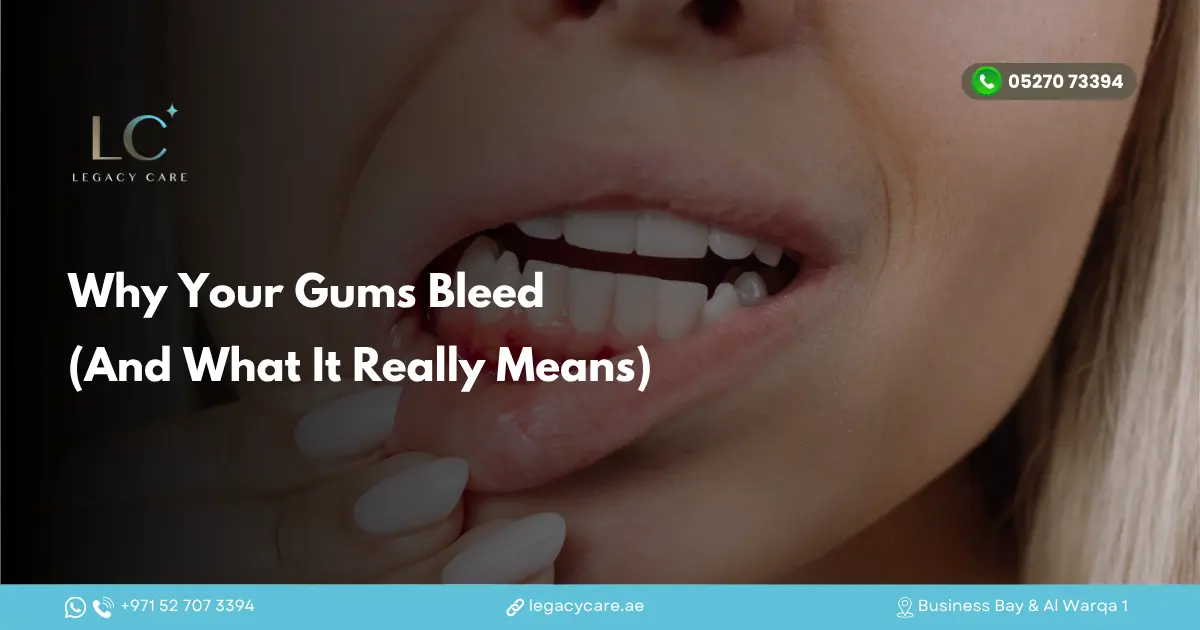
It is a scene that happens in bathrooms all over Dubai every single morning. You finish brushing your teeth, you spit into the sink, and you see a flash of red. For most people, the reaction is to shrug it off. We tell ourselves we just brushed a little too hard or that our toothbrush is getting old. We rinse the sink and move on with our day.
But here’s the thing: your gums are not supposed to bleed. Ever. If your scalp bled every time you brushed your hair, or if your shins bled every time you put on socks, you would probably be rushing to the doctor. Yet, for some reason, we have collectively decided that bleeding gums are just a “normal” part of life.
In reality, those small drops of blood are a loud SOS signal from your body. After years of observing dental health trends, I can tell you that ignoring this signal is one of the biggest mistakes you can make for your long-term health.
It Is Not Just About Brushing Hard
The most common excuse people use is that they have “sensitive gums” or they used a heavy hand with the toothbrush. While it is true that scrubbing your mouth like you’re cleaning a car tire can cause damage, healthy gum tissue is actually quite resilient.
Interestingly, if your gums are healthy, even a firm brushing shouldn’t cause them to bleed. When they do bleed, it is almost always because of inflammation. This inflammation is caused by plaque—that sticky film of bacteria that is constantly forming on your teeth.
What many people don’t realize is that if plaque isn’t thoroughly removed, it hardens into tartar. You can’t brush tartar away; it stays there, irritating the gum tissue and causing it to swell and bleed. This is the first stage of gum disease, known as gingivitis.
The “Silent” Progression
The tricky part about gum issues is that they don’t usually hurt in the beginning. You can have gingivitis for months or even years without feeling a thing. Because there is no pain, we assume there is no problem.
But in reality, that inflammation is a slow-motion disaster. If you don’t address the bleeding, the gingivitis can progress into periodontitis. This is where things get serious. The gums start to pull away from the teeth, creating deep pockets where even more bacteria hide.
Eventually, the infection starts to eat away at the bone that holds your teeth in place. That said, by the time a tooth feels “loose,” you are already in the danger zone. Most tooth loss in adults isn’t actually caused by cavities; it is caused by the bone loss that started with a little bit of blood in the sink.
Your Gums and Your Heart
What many people find surprising is that the health of your mouth is a window into the health of your entire body. We are learning more every year about the “oral-systemic link.”
When your gums are bleeding, you essentially have an open wound in your mouth. This allows bacteria to enter your bloodstream. Studies have shown that the same bacteria found in infected gums can also be found in the plaque that clogs arteries in the heart.
Interestingly, patients with chronic gum disease are often at a higher risk for heart issues and complications with diabetes. Your body is a single, connected system. You cannot have an infected mouth and a perfectly healthy body at the same time.
Small Habits Make the Difference
The good news is that most gum problems are incredibly easy to fix if you catch them early. It doesn’t always require a complex surgery. Often, it just requires a professional cleaning to remove the tartar and a slight adjustment to your routine at home.
Flossing is the big one. Most people skip it because it’s a “hassle,” but the brush simply cannot reach the spaces between your teeth where most gum disease starts. Think of it like washing a plate but only cleaning the top and bottom, leaving the edges dirty.
That said, even the best home routine can’t do everything. You need a professional look under the hood every six months. Using modern tools like digital scanners, a dentist can show you exactly where the inflammation is starting, often before you even see any blood.
Listening to the Signal
At the end of the day, we need to stop treating bleeding gums like a minor annoyance. It is a biological warning. If you see blood when you brush or floss, don’t ignore it and don’t stop brushing that area because it’s “tender.” Usually, the spots that bleed are the ones that need the most attention.
Modern dentistry has made treating gum issues easier and more comfortable than ever. We have treatments like PRP that use your own healing factors to repair tissue, and sedation options for those who are nervous.
The goal isn’t just to stop the bleeding; it’s to protect your smile and your overall health for the long run. When you finally address that inflammation, you’ll notice your mouth feels fresher, your breath is better, and you’ll have the peace of mind that comes with knowing your foundation is solid.
📍 Book a visit at Business Bay or Al Warqa 1
📞 Call +971 527073394
📅 Book Online: https://www.legacycare.ae/book-appointment/