We have all been there. You feel a tiny catch in your tooth while eating, or maybe a quick flash of sensitivity when you sip a cold drink. It is not exactly “pain,” so you ignore it. You tell yourself you’ll mention it at your next checkup—whenever that happens to be.
But here’s the thing about your mouth: it is the only part of your body that does not really have a “self-repair” mode. If you cut your finger, it scabs over. If you bruise your arm, it heals. But if you have a tiny crack or a small spot of decay, it only goes in one direction.
Over the years, I’ve seen countless patients walk into clinics in Dubai thinking they have a minor issue, only to find out they are looking at a major procedure. In reality, most “dental emergencies” started as something very small that was ignored for just a little too long.
The Tiny Cavity That Isn’t So Tiny
Most people think a cavity is a hole they can see in the mirror. Interestingly, by the time you can actually see a hole in your tooth, the decay has likely been working its way through your enamel for months.
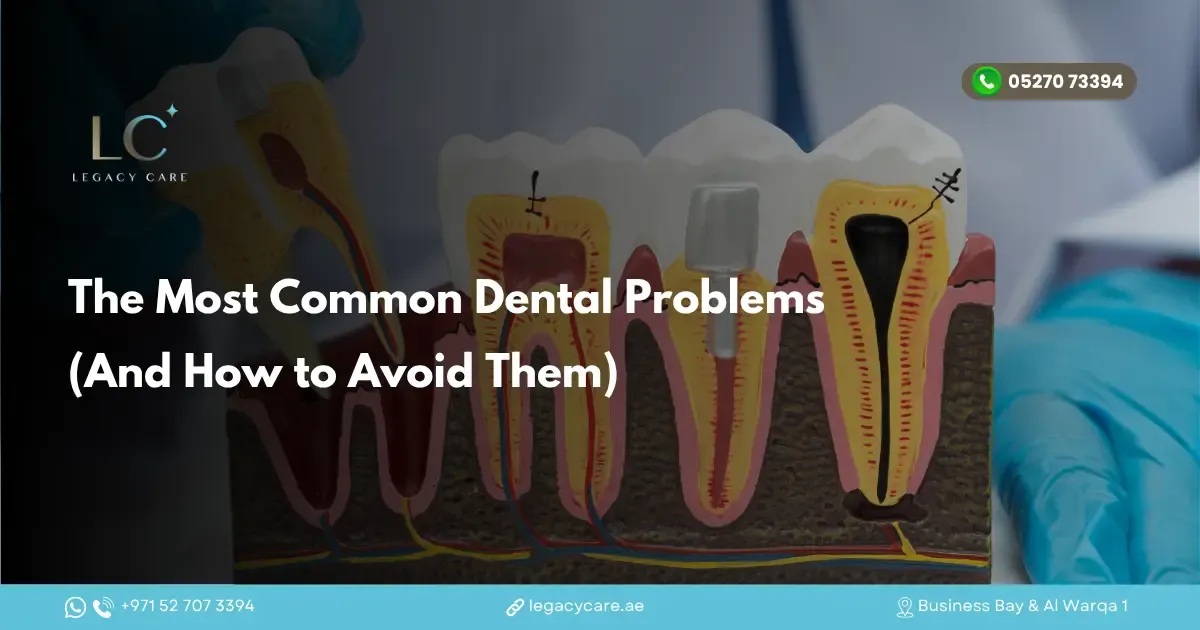
Enamel is incredibly tough, but once bacteria break through that outer shell, they hit the dentin. Dentin is much softer. Think of it like a hard candy with a soft center; once the shell is breached, the middle disappears fast.
What many people don’t realize is that a cavity can grow deep toward the nerve without ever causing a massive toothache. Then, one day, you bite down on something soft and the whole tooth collapses because it was hollowed out from the inside. That small filling you could have had six months ago suddenly turns into a root canal and a crown.
The Bleeding Gums “Phase”
We’ve all seen a little pink in the sink while brushing. It is so common that many people assume it is just part of a normal routine. “Oh, I just brushed too hard,” is the usual excuse.
But in reality, bleeding gums are a direct SOS signal from your body. It is the first stage of gum disease, known as gingivitis. At this stage, it is completely reversible with a professional cleaning and better flossing.
That said, if you ignore that “minor” bleeding, the infection starts to travel down. It begins to eat away at the bone that holds your teeth in place. This is called periodontitis, and it is the leading cause of tooth loss in adults. You don’t want to wait until your teeth feel “loose” to take bleeding gums seriously.
The “Silent” Cracked Filling
Fillings don’t last forever. They live in a harsh environment—subjected to constant pressure, heat, and cold. Over time, a tiny gap can form between the filling and the tooth.
You might not even feel it. But that gap is just wide enough for microscopic bacteria to crawl inside and start a new cavity under the old filling. Because the filling is covering the area, you can’t see the decay, and X-rays are often the only way to catch it.
If you feel a slight “twinge” when you release your bite, or if a tooth feels “different” when you chew, don’t ignore it. Replacing an old filling is simple. Fixing a tooth that has rotted out from under a filling is much, much harder.
Sensitivity That Won’t Quit
We all have moments where ice cream feels a bit too cold. But if you have one specific tooth that reacts every time you drink water, that isn’t just “sensitive teeth.”
Interestingly, localized sensitivity is often a sign of a micro-crack or a receding gum line that has exposed the root. Roots don’t have enamel. They are highly sensitive and prone to rapid decay.
Ignoring that sensitivity is essentially leaving a door open for infection. What starts as a quick zing of pain can quickly turn into a dental abscess—a painful infection at the base of the tooth that can actually make you feel physically ill.
The Value of Catching It Early
It is human nature to avoid the dentist until we absolutely have to go. We are busy, especially in a fast-paced city like Dubai. But the math of dentistry is very simple: the smaller the problem, the cheaper and faster the fix.
Modern technology, like the digital scanners and high-definition imaging we use at Legacy Care, is designed to find these tiny issues before they become “serious.” It allows us to show you exactly what is happening so you can make a decision before the pain starts.
At the end of the day, your teeth are meant to last a lifetime. They are incredibly resilient, but they aren’t invincible. Listening to those small signals—the tiny aches, the minor bleeding, the slight sensitivity—is the best way to ensure you never have to deal with a real dental disaster.
It is always better to have a quick, boring checkup today than an emergency surgery tomorrow.
📍 Book a visit at Business Bay or Al Warqa 1
📞 Call +971 527073394
📅 Book Online: https://www.legacycare.ae/book-appointment/